
Essential details
Quantity(pieces):1
Shipping:Sea transport
Package Description:wooden case
Product Introduction
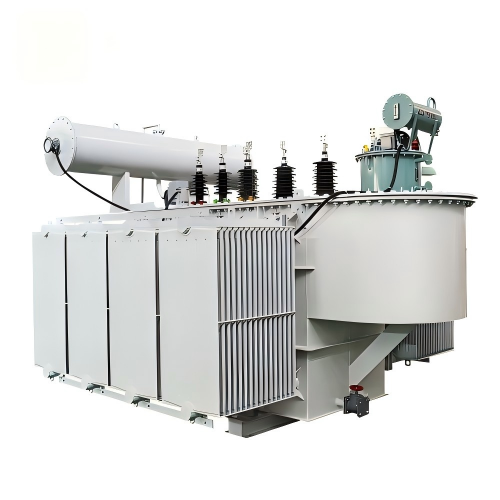
The 66kV oil-immersed power transformer is a power equipment with a rated voltage of 66kV, using insulating oil as the main insulation and cooling medium. It is mainly used for power transmission, distribution and voltage transformation in regional power grids, substations and large industrial and mining enterprises.
I. Core Structure
1. Body (Core)
Core: Made of high-magnetic-conductivity grain-oriented cold-rolled silicon steel sheets, with full bevel joints and no holes for binding, forming a closed magnetic circuit.
Windings: High and low voltage windings (copper/aluminum material) are concentrically wound around the core column, with insulation paper / cardboard between layers to ensure electrical strength.
Insulation: The windings are reliably insulated from the core and each other through insulating oil and solid insulating components (paper tubes, support rods).
2. Oil Tank and Cooling System
Oil Tank: Steel container, holding insulating oil, protecting the body and participating in heat dissipation.
Cooling Device:
Natural Oil Circulation (ONAN): Relying on oil convection to cool the oil flowing through the oil tank wall / heat exchanger.
Forced Oil Circulation (OFAF/ODAF): Equipped with oil pumps and fans to enhance the cooling capacity.
3. Main Accessories
1. Body (Core)
Core: Made of high-magnetic-conductivity grain-oriented cold-rolled silicon steel sheets, with full bevel joints and no holes for binding, forming a closed magnetic circuit.
Windings: High and low voltage windings (copper/aluminum material) are concentrically wound around the core column, with insulation paper / cardboard between layers to ensure electrical strength.
Insulation: The windings are reliably insulated from the core and each other through insulating oil and solid insulating components (paper tubes, support rods).
2. Oil Tank and Cooling System
Oil Tank: Steel container, holding insulating oil, protecting the body and participating in heat dissipation.
Cooling Device:
Natural Oil Circulation (ONAN): Relying on oil convection to cool the oil flowing through the oil tank wall / heat exchanger.
Forced Oil Circulation (OFAF/ODAF): Equipped with oil pumps and fans to enhance the cooling capacity.
3. Main Accessories
Oil Sump: Adjusts oil volume, isolates air, and slows down oil aging.
Breather: Adsorbs moisture in the air.
Tap Switch: No-excitation voltage regulation (±5% or ±2×2.5%) or on-load voltage regulation (with load voltage adjustment).
Protection Devices: Gas relay (internal fault protection), pressure relief valve, thermometer, oil level gauge.
Bushing: High and low voltage leads are led out of the oil tank to achieve insulation against the ground.
Breather: Adsorbs moisture in the air.
Tap Switch: No-excitation voltage regulation (±5% or ±2×2.5%) or on-load voltage regulation (with load voltage adjustment).
Protection Devices: Gas relay (internal fault protection), pressure relief valve, thermometer, oil level gauge.
Bushing: High and low voltage leads are led out of the oil tank to achieve insulation against the ground.
II. Working Principle
Based on the law of electromagnetic induction:
66kV alternating current is introduced to the high-voltage side → alternating magnetic flux is generated in the core.
The magnetic flux passes through the low-voltage winding → different voltages (U₁/U₂ = N₁/N₂) are induced.
The insulating oil also performs both insulation and heat-conducting functions simultaneously.
Typical Model: S11/S13-6300/66, SFZ11-31500/66
S: Three-phase; F: Air-cooled; Z: On-load voltage regulation; 11/13: Performance sequence; 6300: Capacity (kVA); 66: High-voltage side voltage (kV).
Capacity Range: 630 kVA ~ 63,000 kVA (Common: 6300 ~ 40,000 kVA).
Voltage Combinations:
High Voltage: 66 ± 2 × 2.5% kV
Low Voltage: 6.3 kV / 6.6 kV / 10.5 kV / 11 kV
Connection Group Number: YNd11 (High-voltage star, Low-voltage delta, 11 phase difference).
Short-circuit Impedance: 9% ~ 12% (Dependent on capacity).
IV. Performance Characteristics
Advantages
Excellent insulation and heat dissipation: The oil medium has stable performance and strong overload capacity.
Mature technology, high reliability, long lifespan (up to 20-30 years).
Lower cost, rich maintenance experience.
Good short-circuit resistance, suitable for outdoor harsh environments.
V. Application Scenarios
66kV regional substations (downgrading to 10kV distribution network).
Main transformers or tie transformers in large power plants / substations.
Large-capacity, high-reliability power loads in industries such as metallurgy, petrochemicals, and mining.
VI. Execution Standards
GB 1094: "Power Transformers"
GB/T 6451: "Technical Parameters and Requirements for Three-Phase Oil-Immersed Power Transformers"
IEC 60076 International Standard
VII. Selection Key Points
1. Select the rated capacity according to the load (leave a 15-20% margin).
2. Determine the voltage regulation mode: no excitation (load stable) or on-load (voltage fluctuation large).
3. Select the cooling method (ONAN/OFAF) and protection level according to the environment.
4. Prioritize low-loss types (S11/S13/S15) to reduce operating costs.
Advantages
Excellent insulation and heat dissipation: The oil medium has stable performance and strong overload capacity.
Mature technology, high reliability, long lifespan (up to 20-30 years).
Lower cost, rich maintenance experience.
Good short-circuit resistance, suitable for outdoor harsh environments.
V. Application Scenarios
66kV regional substations (downgrading to 10kV distribution network).
Main transformers or tie transformers in large power plants / substations.
Large-capacity, high-reliability power loads in industries such as metallurgy, petrochemicals, and mining.
VI. Execution Standards
GB 1094: "Power Transformers"
GB/T 6451: "Technical Parameters and Requirements for Three-Phase Oil-Immersed Power Transformers"
IEC 60076 International Standard
VII. Selection Key Points
1. Select the rated capacity according to the load (leave a 15-20% margin).
2. Determine the voltage regulation mode: no excitation (load stable) or on-load (voltage fluctuation large).
3. Select the cooling method (ONAN/OFAF) and protection level according to the environment.
4. Prioritize low-loss types (S11/S13/S15) to reduce operating costs.